Purchasing PicoPOL
PicoPOL polarimeters can be purchased on the Instruments4Chem eBay store. Current pricing and availability are listed on eBay, while detailed documentation and supporting information are provided here on the website. The PicoPOL is supplied as a set of pre-built modules—source, detector, and controller (–OLED or –PC)—together with all mechanical components required to assemble the complete instrument.
What is Supplied The system includes all essential components required for straightforward assembly:
Detailed component lists are available here (–OLED version) and here (–PC version).
Power Supply Requirement A regulated 9V power supply is required but not included.
Further details can be found here (–OLED version) and here (–PC version).
Assembly and User Experience Assembly is straightforward and typically takes around 10–20 minutes. The use of pre-built modules removes the need for soldering or sourcing electronic components, allowing users to focus on the instrument itself rather than its construction. This approach retains many of the educational and practical benefits of a kit—providing insight into the instrument architecture—while significantly reducing complexity and build time.
Enclosure Design Transparency For those interested in the mechanical design, the PicoPOL enclosure .stl files are available for download here. These allow users to examine the structure and layout of the optical bench and controller housing. There is no requirement to use or print these files—the supplied system includes professionally manufactured 3D-printed components with consistent dimensional accuracy and reliable fit.
Who is PicoPOL For? PicoPOL is designed for teaching laboratories, demonstrations, and independent experimentation. It is particularly well suited to users who value both performance and an understanding of how the instrument operates. While assembly is simple, users should be comfortable with basic mechanical assembly and careful handling of optical components.
Looking Ahead We aim to foster a user community around PicoPOL and other Instruments4Chem systems, where users can share experimental approaches, teaching ideas, and practical insights. This will grow alongside the release of additional instruments, all supported by detailed documentation and performance data.
Support For further information or assistance, please contact:
PicoPol@instruments4chem.com
- • Pre-built source and detector modules for the optical bench
- • Pre-built controller module (RPi PICO-based)
- • Fully programmed for the –OLED version
- • Firmware installation required for the –PC version
- • Precision 3D-printed enclosure components (optical bench and controller housing)
- • Laser-cut optical bench baseplate
- • NEMA-11 stepper motor
- • Two custom polarizer disks
- • A 2.8” OLED panel and IR remote (–OLED version)
- • A polarimeter cell
- • Interconnecting cables
- • Complete assembly hardware
Detailed component lists are available here (–OLED version) and here (–PC version).
What's in an Assembled PicoPol Optical Bench ?
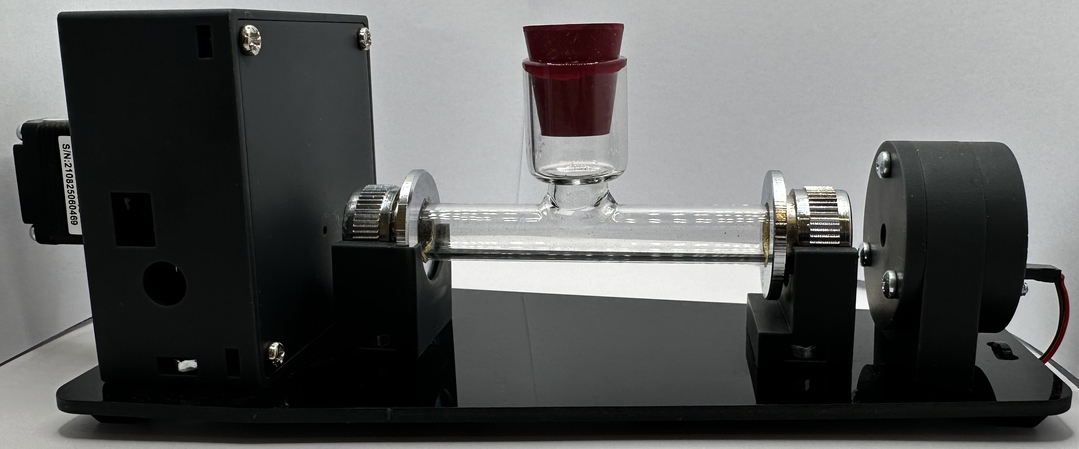
The polarimeter optical bench is constructed using 3D-printed components and features a fully enclosed LED source PCB paired with a defining polarizer. The standard configuration includes a 590 nm yellow LED, but the system can be adapted to other wavelengths by selecting a suitable LED. On the detection side, a PCB housed in an enclosure is equipped with an analyzing polarizer.
Additional components to complete the optical bench include:
• A NEMA-11 stepper motor
• A 10 cm Glass Agencies polarimeter cell with two support cradles
• A 2-wire ribbon cable for connecting the detector and source
• A cell cover to shield the detector from ambient light during measurements
The optical bench connects to a control interface via a USB-mini-B to USB-A cable. This interface is based on the RPi PICO controller and is available in two configurations, described below, to manage and operate the instrument effectively.
Additional components to complete the optical bench include:
• A NEMA-11 stepper motor
• A 10 cm Glass Agencies polarimeter cell with two support cradles
• A 2-wire ribbon cable for connecting the detector and source
• A cell cover to shield the detector from ambient light during measurements
The optical bench connects to a control interface via a USB-mini-B to USB-A cable. This interface is based on the RPi PICO controller and is available in two configurations, described below, to manage and operate the instrument effectively.
What's the -OLED Interface Option ?
The PicoPol-OLED option is a polarimeter intended to be used as a stand-alone device, making it ideal for single-point optical rotation measurements. While kinetic runs can still be performed, users must manually log optical rotation vs. time data.
The -OLED controller is housed in a 3D-printed enclosure that contains an assembled PCB featuring a 2.8” OLED panel and a pre-programmed Raspberry Pi PICO. User interaction with the instrument is managed via an included IR remote keypad. The interface PCB also includes a USB-Type-A connector for connecting the controller to the polarimeter optical bench, and the required cable is provided.
Power for the PicoPol instrument is supplied by a 9V plug-pack, and a custom cable is also included to deliver power from the interface PCB to the polarimeter optical bench.
For detailed setup and measurement instructions specific to the PicoPol-OLED version, please refer to our PicoPol-OLED interface page.
The -OLED controller is housed in a 3D-printed enclosure that contains an assembled PCB featuring a 2.8” OLED panel and a pre-programmed Raspberry Pi PICO. User interaction with the instrument is managed via an included IR remote keypad. The interface PCB also includes a USB-Type-A connector for connecting the controller to the polarimeter optical bench, and the required cable is provided.
Power for the PicoPol instrument is supplied by a 9V plug-pack, and a custom cable is also included to deliver power from the interface PCB to the polarimeter optical bench.
For detailed setup and measurement instructions specific to the PicoPol-OLED version, please refer to our PicoPol-OLED interface page.
What about the -PC Interface Option ?
The PicoPol-PC option offers a cost-effective solution for connecting the polarimeter optical bench to a PC, enabling the logging of optical rotation data. This version features a compact 3D-printed enclosure housing a breakout PCB that integrates a Raspberry Pi PICO and a USB-Type-A connector.
To operate the instrument, the following components are included:
• A USB-A to USB-mini-B cable for connecting the polarimeter optical bench
• A USB-micro cable for interfacing with your PC
• A 9V plug-pack for powering the system
The PicoPol-PC version is designed to be controlled via LabVIEW™ on your PC. For more details, including photos of the enclosure, the RPi PICO, and connection configurations, visit the bottom section of our PicoPol-PC interface page.
To operate the instrument, the following components are included:
• A USB-A to USB-mini-B cable for connecting the polarimeter optical bench
• A USB-micro cable for interfacing with your PC
• A 9V plug-pack for powering the system
The PicoPol-PC version is designed to be controlled via LabVIEW™ on your PC. For more details, including photos of the enclosure, the RPi PICO, and connection configurations, visit the bottom section of our PicoPol-PC interface page.
Purchasing & Supply Details
PicoPOL-OLED and PicoPOL-PC systems are available exclusively through the Instruments4Chem eBay store.
Both configurations are normally supplied fitted with a yellow (≈590 nm) source LED. Alternative source wavelengths may be available on request.
All mechanical components required to construct the optical bench and RPi PICO controller housing are included as precision 3D-printed parts supplied as assembled modules. These have been professionally manufactured to ensure consistent dimensional accuracy and reliable alignment.
For users interested in the mechanical design, zipped sets of .stl files are also available for download. These are provided for reference only and allow inspection of the enclosure structure—there is no requirement to print or source these parts separately.
To support international use and avoid compatibility issues with regional mains standards and plug types, a power supply is not included. The instrument requires a standard 9 V DC regulated supply capable of at least 1 A. Connection to PicoPOL is via a 2.5 mm inner diameter DC barrel plug (tip positive) with a metal barrel length of at least 12 mm. Compatible plug packs are widely available.
For further information or technical enquiries, please contact: PicoPol@instruments4chem.com
Both configurations are normally supplied fitted with a yellow (≈590 nm) source LED. Alternative source wavelengths may be available on request.
All mechanical components required to construct the optical bench and RPi PICO controller housing are included as precision 3D-printed parts supplied as assembled modules. These have been professionally manufactured to ensure consistent dimensional accuracy and reliable alignment.
For users interested in the mechanical design, zipped sets of .stl files are also available for download. These are provided for reference only and allow inspection of the enclosure structure—there is no requirement to print or source these parts separately.
To support international use and avoid compatibility issues with regional mains standards and plug types, a power supply is not included. The instrument requires a standard 9 V DC regulated supply capable of at least 1 A. Connection to PicoPOL is via a 2.5 mm inner diameter DC barrel plug (tip positive) with a metal barrel length of at least 12 mm. Compatible plug packs are widely available.
For further information or technical enquiries, please contact: PicoPol@instruments4chem.com
Sourcing Polarimeter Cells
A search of the internet reveals many suppliers of polarimeter cells. Cells offered by the manufacturers of high-end polarimeters are of the highest quality (in regards both dimensional tolerance and window perfection) but these are also generally the most expensive, often costing hundreds of dollars.
After testing a number of lower cost options, we have settled on the "Polarimeter Tube with Center Cup" shown opposite and sold by Glass Agencies. These cells are well made and in our experience they deliver good results and at a very reasonable price.
To enable you to get started, each PicoPol instrument kit is supplied with one cell, but if you require additional cells please order these directly from Glass Agencies.
After testing a number of lower cost options, we have settled on the "Polarimeter Tube with Center Cup" shown opposite and sold by Glass Agencies. These cells are well made and in our experience they deliver good results and at a very reasonable price.
To enable you to get started, each PicoPol instrument kit is supplied with one cell, but if you require additional cells please order these directly from Glass Agencies.
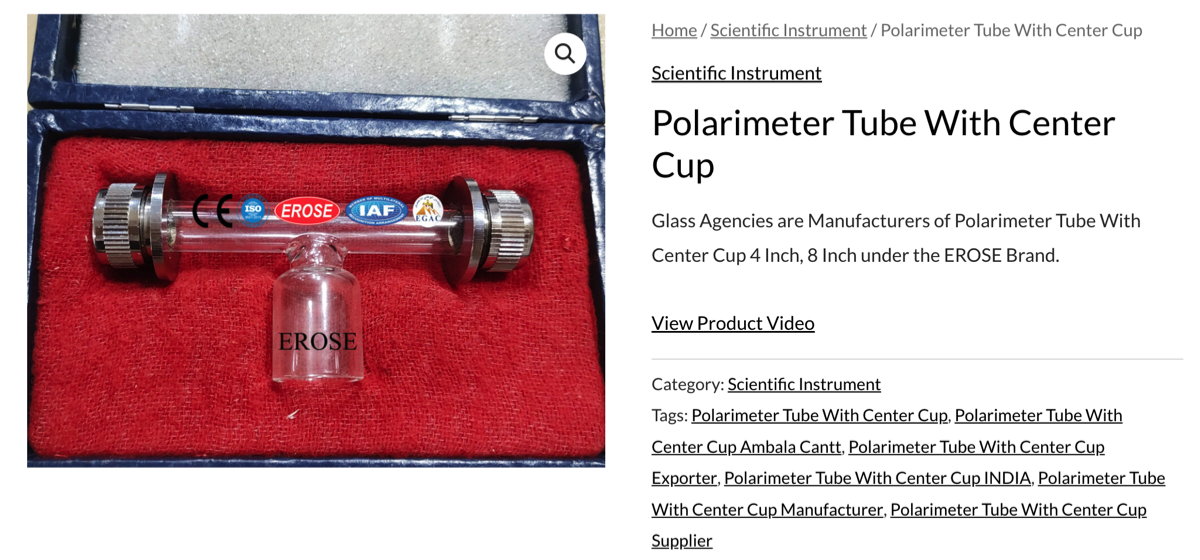
The Glass Agencies polarimeter cell (email : glassagencies@gmail.com). If ordering from this supplier be sure to request a stopper for the cell.
Should you wish to use your own polarimeter cell(s), different cell cradles may need to be 3D-printed to accomodate these. If this is your requirement email us at picopol@instruments4chem.com and we will provide advice and assistance.
Should you wish to use your own polarimeter cell(s), different cell cradles may need to be 3D-printed to accomodate these. If this is your requirement email us at picopol@instruments4chem.com and we will provide advice and assistance.